

Skip to content

Ask a question

What are you looking for?

Start by picturing the desk in both its daytime and nighttime states.

How to Build a Desk Setup: Layering, Space, and Light

Build a desk that solves three problems: sit comfortably, look tidy, stay in reach. Layer with a riser, leave clear space, and plan two lighting states.

Matrix Lab Carnival Alice Review: A 10th Anniversary Alice Board Reading How to Build a Desk Setup: Layering, Space, and Light 4 min read Next Spotlight Desk Fan Review: Retro Light and 100 Speeds

A desk that actually works comes down to three things: Can you sit comfortably? Does it look clean without feeling sterile? And can you reach everything you need? The setup below tackles all three by playing with height, negative space, light, and just a touch of color.

What a Desk Really Needs to Do

Start by picturing the desk in both its daytime and nighttime states.
Fig. 1. Picture your desk in daylight, then at night.

Skip the shopping list for a second. Start with what actually matters:

1. You should be able to sit down and feel good about it.

2. The surface shouldn't look like a disaster zone.

3. You need to grab things without thinking.

Everything else follows from those three. And if you can nail the setup so it works both during the day and after dark, you know you've got something solid.

Stack Things Vertically Instead of Flat

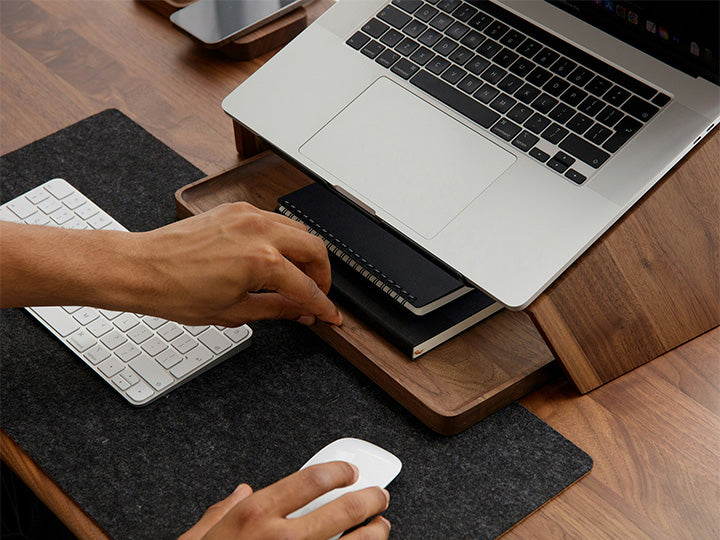
Raise the monitor on a riser so the speaker and keyboard sit beneath it.
Fig. 2. Lift the monitor; keyboard and speaker go underneath.
Stand the speaker on the riser so it sits level with the screen, not in front of it.
Fig. 3. Put the speaker at screen height, not in the way.
Choose a riser with front-facing controls so you never reach behind the screen.
Fig. 4. Front controls mean no reaching behind the monitor.

A monitor riser changes everything. Suddenly you've got layers—the screen up top, speakers and keyboard in the middle, mouse area in front. The desk stops looking like one flat plane and starts looking intentional. Plus, it photographs way better and feels more organized in actual use.

Give the Keyboard Area Some Breathing Room

Keep the keyboard and mouse area clear and let the riser light do the work.
Fig. 5. Clear space around the keyboard; let the light do the work.
Same arrangement, two moods—check the layout at midday and again at night.
Fig. 6. Same desk, two different vibes—midday and nighttime.

Don't crowd it. The thing people actually notice on a nice desk isn't the stuff on it—it's the empty space around it. Look down from above: if your mouse area feels cramped, something's gotta move. Less stuff, more breathing room. That's the formula.

Light Does Two Jobs

One small lamp changes how the whole desk reads after dark.
Fig. 7. One lamp shifts the whole mood after dark.
Pair a warm lamp with cool blue light so the night desk does not go flat.
Fig. 8. Mix warm and cool light for depth at night.
Press the front buttons to shift color temperature as the day moves on.
Fig. 9. Adjust color temperature from the front controls.
Warm light on the same corner: blue and orange contrast carries the night look.
Fig. 10. Warm and cool together create that cinematic night look.

Think of your desk as two different things: a work machine by day, something more atmospheric at night. During the day, bright and minimal. When the sun sets, the contrast between blue and warm orange is what makes it feel like something out of a film. Get a light with adjustable color temperature that you can control from the front—no rewiring, just flip it when the mood needs to shift.

One or Two Colors Anchor Everything

Let one red piece, like this cased mouse, carry the accent against black and silver.
Fig. 11. One red accent breaks up the black and silver.
A yellow mousepad breaks up a black, white and silver palette.
Fig. 12. A yellow mousepad prevents the whole thing from feeling cold.
Give the eye one landing point—a model car between the keyboard and the mouse.
Fig. 13. One accent object for the eye to land on.

Keep the base neutral—black, white, silver. Then introduce one color to break it up. Maybe a yellow mousepad, a red mouse, the riser shifting to warm light. The accent should feel like a choice, not an accident. That's the difference between curated and cluttered.

Small Objects Add Personality Without Clutter

Leave the mousepad open; one small model adds mood without filling the surface.
Fig. 14. One small model adds mood without crowding the desk.
Set figurines on top of the PC case, clear of the keyboard and mouse area.
Fig. 15. Put figurines on the PC case, out of the work zone.

A few small things are fine—a model, a figurine, something with sentimental value. They're there to add feeling, not to fill space. That restraint is what keeps everything from sliding back into looking like a mess.

Editor's Notes & Summary

Building a desk is about arranging thoughtfully, not just stacking stuff. Hit those three conditions, keep things out of your way, and you're done. That's the whole game.


10 comments
  • Yes, you’ve got good taste!!

     Jordan Lee

  • The UMX tree lamp! It looks great.

     Noah Wilson

  • Oh wow, I forgot to reply—thanks, kind internet friend.

     Avery Mitchell

  • What’s the mousepad?

     Mia Cooper

  • Another post that gets me wanting to buy. If I keep following this, Douyin installment plans won’t be enough for me.

     Ethan Parker

  • Is that Horizon 6?

     Taylor Brooks

  • I’m here to learn!

     Maya Collins

  • It’s Lian Li’s Bauhaus.

     Chris Bennett

  • What’s the PC case?

     Nora Hayes

  • Chovy, don’t do it, man!

     Daniel Foster

Leave a comment

Continue reading

Desk Setup Lab

Your daily source for desk setup ideas, gear reviews, and workspace inspiration.

English
  • English
  • русский
BlogCartWishlist